
Direct answer for buyers
American Mahjong is one of the fastest-growing tabletop game categories in the U.S., with an estimated 500,000+ active players. Demand for private label sets from retailers, gift shops, bridal shower brands, and boutique wholesalers is surging.
The question is not whether to source — it is where, how, and what specifications to demand. This guide covers the exact tile specs, MOQ realities, customization options, and the sourcing path that experienced buyers recommend for NMJL-compliant private label American Mahjong sets from Chinese manufacturers.
Key takeaways
- American Mahjong is one of the fastest-growing tabletop game categories in the U.S., with an estimated 500,000+ active players.
- The question is not whether to source — it is where, how, and what specifications to demand.
- Before talking about where to source, let's establish what you're actually sourcing.
On this page
- What U.S. Buyers Need in a Private Label American Mahjong Set
- Why Shenzhen and Guangdong Are the Strong Sourcing Hubs for American Mahjong
- MOQ Reality: What to Expect and How to Negotiate
- Private Label Customization Options
- Sample Checklist Before Bulk Production
- Direct Factory vs. Alibaba / Global Sources / Trading Company
- About Lucky Mahjong
- Frequently Asked Questions
- Buyer checklist
- Production notes
- Related buyer guides
What U.S. Buyers Need in a Private Label American Mahjong Set
Before talking about where to source, let's establish what you're actually sourcing. A retail-ready private label American Mahjong set for the U.S. market must include specific components to meet NMJL gameplay standards and consumer expectations.
Core Tile Specifications
| Component | Specification | Why It Matters |
|---|---|---|
| Total tiles | The American Mahjong core contains 152 tiles: 108 suited tiles, 16 winds, 12 dragons, 8 flowers and 8 jokers. A 160-tile retail configuration adds 8 specified extras; a 166-tile configuration adds 14. List the extra faces and quantities in the buyer-approved manifest rather than treating either retail total as a universal requirement. | NMJL gameplay requires 160 tiles minimum (152 + 8 Jokers) |
| Suit tiles | 3 suits (Craks, Dots, Bams) × 9 numbers × 4 copies = 108 tiles | Standard across all American Mahjong sets |
| Honor tiles | 4 Winds (N, E, S, W) × 4 + 3 Dragons (Red, Green, Blue) × 4 = 28 tiles | Universal tile set requirement |
| Jokers | 8 Jokers | Essential for American Mahjong — no Jokers means the set is not NMJL-compliant |
| Blank spares | 2-6 blank tiles | Allows replacement if tiles are lost or damaged |
| Tile markings | Arabic numerals, English letters (N, E, S, W), Western symbols | American players expect Western markings, not Chinese characters |
| Tile material | Melamine, multi-layer acrylic (including 4-layer acrylic with glitter or embedded patterns), or resin | Directly affects retail price positioning and perceived quality. Multi-layer acrylic with custom glitters and translucent colors is the premium standard for boutique brands. |
Essential Accessories
A complete retail-ready set should also include:
- 4 tile racks with pushers (individual player trays)
- Dice (2-3 standard dice)
- Betting chips or coins (optional but expected by U.S. consumers)
- Storage solution — carrying bag, case, or retail box
- NMJL card placeholder or beginner guide insert (optional value-add)
- Barcode label (UPC) for retail scanning
Without racks and pushers, American Mahjong is difficult to play. These are not optional accessories in the U.S. market — they are expected.
Why Shenzhen and Guangdong Are the Strong Sourcing Hubs for American Mahjong
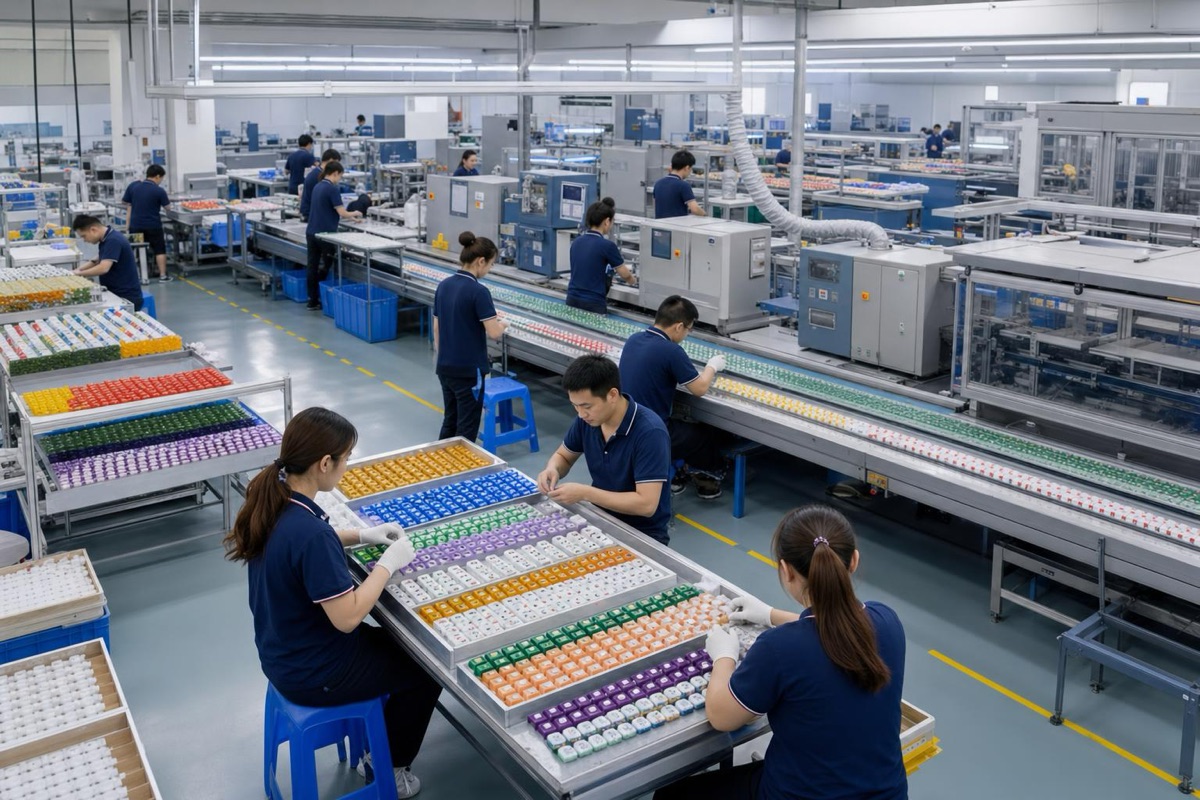
China's Guangdong province — and specifically the Shenzhen-Dongguan-Huizhou manufacturing corridor — has become the dominant production hub for American Mahjong sets exported to the U.S. market.
Mature multi-layer acrylic and melamine manufacturing. The same factories that produce premium acrylic housewares, cosmetic packaging, and craft components have the equipment, material supply chains, and quality control processes needed for mahjong tile production. Deep engraving on acrylic tiles, multi-layer construction (including 4-layer acrylic with custom glitters and embedded patterns), precision paint-fill coloring, and UV-cured finishes are standard capabilities in this region. Factories familiar with layered acrylic, engraved paint-fill production, premium racks and pushers, and boutique packaging tend to perform much better for boutique retailers than generic board game factories.
Proximity to Hong Kong and global shipping ports. Shenzhen Yantian Port and Nansha Port (Guangzhou) support export shipping to U.S. ports, with timing confirmed by route, season, freight method, and customs handling. Air freight options can be reviewed for sample shipments and rush orders.
Experience with American Mahjong specifically. Unlike generic board game factories, the best Shenzhen-based mahjong manufacturers understand the NMJL tile count, Western marking conventions, Joker requirements, rack dimensions, and U.S. retail packaging expectations. This specialized knowledge prevents costly mistakes — wrong tile counts, Chinese character markings instead of Western numerals, or missing Jokers.
Private label and OEM infrastructure. Guangdong's manufacturing ecosystem includes custom packaging printing, retail box design, barcode label application, insert printing, and drop-shipping logistics. Buyers can source a fully retail-ready product from a single supplier rather than coordinating multiple vendors.
| Brand Stage | Recommended Factory Type | What to Look For |
|---|---|---|
| First launch / starter project | Flexible boutique-focused factory | Scope-based MOQ, standard Western markings, branded bag/box |
| Luxury lifestyle brand | Premium acrylic specialist | Multi-layer acrylic, custom glitters, deep engraving, premium cases |
| Scaling retail distribution | Larger OEM manufacturer | Consistent quality, competitive pricing, on-time delivery |
| Amazon price competition | Generic mass-production factory | Lowest unit cost, fast turnaround, basic packaging |
MOQ Reality: What to Expect and How to Negotiate
One of the most common questions from first-time buyers is about Minimum Order Quantity. Here's the reality:
| Buyer Type | Typical MOQ Range | Customization Level | Best For |
|---|---|---|---|
| Starter / test market | Confirmed during quotation | Logo on bag/box, standard tile design | Proof of concept, small boutiques, market testing |
| Growing wholesale | 200-500 sets | Custom tile backs, custom jokers, branded packaging | Established retailers, gift shops, bridal brands |
| Full private label program | 500-1,000+ sets | Full custom tile faces, unique colorways, retail-ready packaging | Major brands, large distributors, subscription boxes |
Why MOQ Varies So Much
MOQ depends on several factors:
- Tile customization depth. Standard tiles with a logo on the bag have lower MOQ than fully custom-engraved tile faces with unique artwork.
- Material choice. Melamine tiles typically have lower MOQ than acrylic because the production process is simpler and less material-specific.
- Packaging complexity. A simple carrying bag costs less to customize than a four-color printed retail box with foam inserts.
- Factory capacity and scheduling. During peak seasons (Q3-Q4 for holiday gift orders), factories may raise MOQ to manage production capacity.
MOQ Negotiation Tips
- Start with the factory's standard tile design. Many Shenzhen manufacturers offer "stock designs" that already include Western markings and NMJL-compliant tile counts. Adding your logo to the packaging or bag is a low-cost, low-MOQ customization.
- Combine product lines. If you're ordering multiple product variants (e.g., a melamine set and an acrylic set), some factories will lower the per-SKU MOQ when total order volume is higher.
- Ask about "trial orders." Some manufacturers offer scope-based starter orders for U.S. buyers who want to test market response before committing to larger volumes.
- Be transparent about your growth plan. Factories are more likely to accommodate lower MOQ when they see a clear path to larger reorders.
Private Label Customization Options
Here's a comprehensive list of what can be customized on a private label American Mahjong set:
Tile Customization
| Option | Description | Difficulty | MOQ Impact |
|---|---|---|---|
| Tile back design | Custom color, pattern, or logo on the back of every tile | Low | Minimal |
| Custom Jokers | Unique Joker design matching your brand theme | Low-Medium | Low |
| Custom tile faces | Unique suit colors, fonts, or decorative elements on tile faces | High | Higher MOQ |
| Tile material | Choose between melamine, acrylic, or resin | Low | Varies by material |
| Tile size | Standard (30mm) or oversized/large-print (35-38mm) | Low-Medium | Minimal |
Packaging Customization
| Option | Description | Difficulty | MOQ Impact |
|---|---|---|---|
| Branded carrying bag | Logo and colors on canvas or polyester bag | Low | Minimal |
| Custom retail box | Full-color printed box with brand graphics | Medium | Moderate |
| Foam inserts | Custom-molded or die-cut foam for tile organization | Medium | Moderate |
| Insert cards | NMJL beginner guide, care instructions, brand story card | Low | Minimal |
| Barcode (UPC) labels | Applied to retail box for POS scanning | Low | None |
| Hang tags | Branded hang tag with product information | Low | Minimal |
Brand Identity Elements
- Logo placement on bags, boxes, tile backs, and instruction inserts
- Brand colors applied to packaging and optionally to tile backs
- Custom product names (e.g., "The [Brand] Collection American Mahjong Set")
- Care instructions and warranty cards with brand contact information
Sample Checklist Before Bulk Production
Before approving a bulk production run, U.S. buyers should verify the following with their sample:
Tile Quality Checks
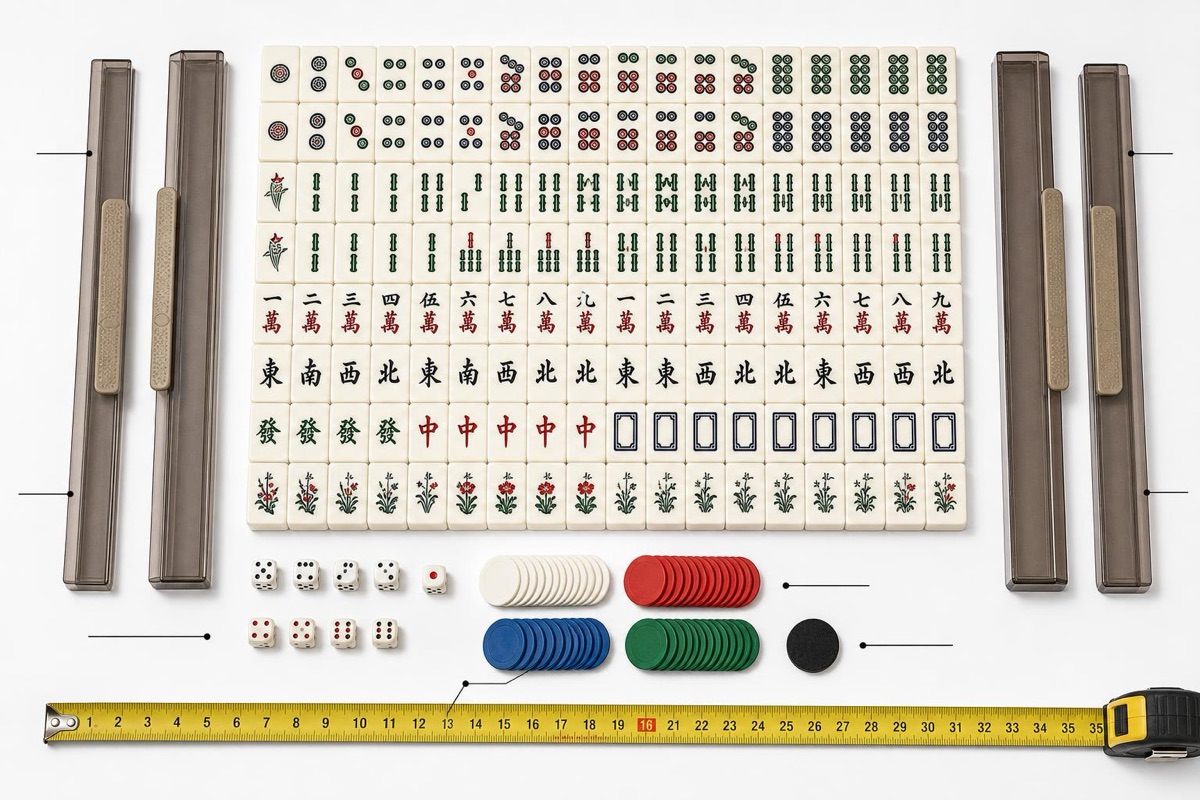
- The American Mahjong core contains 152 tiles: 108 suited tiles, 16 winds, 12 dragons, 8 flowers and 8 jokers. A 160-tile retail configuration adds 8 specified extras; a 166-tile configuration adds 14. List the extra faces and quantities in the buyer-approved manifest rather than treating either retail total as a universal requirement.
- Western markings: All tiles use Arabic numerals and English letters (no Chinese characters on standard sets)
- Joker presence: 8 Jokers included with American Mahjong styling
- Tile dimensions: Consistent size across all tiles (standard is approximately 30mm × 22mm × 12mm)
- Engraving depth: Engraved details are deep enough to be tactile (not surface-printed only)
- Color consistency: Tile face colors are uniform across the full set
- Edge quality: No sharp edges, chipping, or flashing on any tile
Accessory Checks
- Racks included: 4 racks with pushers (or as specified in order)
- Rack dimensions: Tiles fit securely in racks without wobbling or falling out
- Pushers attached: Pushers are properly fitted and slide smoothly
- Dice included: 2-3 standard dice as specified
- Chips/coins included: If part of the set specification
Packaging Checks
- Bag/box branding: Logo, colors, and text match approved design
- Insert placement: Instruction cards, care guides, and warranty cards are included
- Barcode (UPC): Correct barcode applied and scannable
- Box construction: Retail box is sturdy, with no glue failures or corner damage
- Drop test: Packaged set survives a standard drop test without tile damage
Documentation
- Packing list: Matches order contents
- QC photos: Factory provides pre-shipment quality control photos
- Shipping marks: Carton labels are correct for freight forwarding
- Compliance documentation: Any required certifications or test reports (if applicable)
Direct Factory vs. Alibaba / Global Sources / Trading Company
There are three main sourcing paths for U.S. buyers looking for Chinese private label American Mahjong sets:
Path 1: Direct Factory (Recommended for Experienced Buyers)
What it is: Sourcing directly from a manufacturer like Lucky Mahjong (Shenzhen Nuolanxiang Trading Co., Ltd.) that operates its own production lines.
Advantages: Lower unit cost (no middleman margin), direct communication about tile specifications and QC, faster turnaround on custom orders, greater control over customization depth, factory understands NMJL requirements and U.S. market expectations.
Considerations: Requires more buyer knowledge about production processes, communication is typically in English, payment terms may be less flexible than trading companies, buyer manages logistics (or factory can arrange freight).
Best for: Established brands, retailers with reorder volume, buyers who need deep customization and consistent quality over multiple production runs.
Path 2: Sourcing Platforms (Alibaba, Global Sources, Made-in-China)
What it is: Searching for suppliers on B2B platforms and communicating through the platform's messaging and order system.
Advantages: Large supplier selection, platform buyer protection and dispute resolution, easy to compare pricing across suppliers, Trade Assurance and payment escrow options.
Considerations: Many listings are from trading companies, not factories. Limited ability to verify actual production capabilities. Tile specifications may be generic — not optimized for NMJL American Mahjong. Communication can be slow and responses templated. Higher risk of receiving wrong tile counts, missing Jokers, or Chinese character markings.
Best for: Initial research, price benchmarking, and first-time buyers who want platform protection.
Path 3: Trading Company / Sourcing Agent
What it is: Working with a trading company or sourcing agent based in China who coordinates manufacturing on your behalf.
Advantages: Can manage multiple suppliers and components, handles logistics, customs documentation, and quality inspection, lower communication barrier for first-time importers, can consolidate shipments from multiple factories.
Considerations: Higher unit cost (trading company margin is added), less direct control over factory-level quality, potential information gap between buyer and actual manufacturer, may not specialize in American Mahjong specifications.
Best for: First-time importers, buyers sourcing multiple product categories, or those who need full-service logistics support.
For American Mahjong specifically, direct factory sourcing usually delivers the best results because the product has specialized requirements (NMJL tile count, Western markings, Joker inclusion, rack dimensions) that generic trading companies and platform suppliers often get wrong. A factory that specializes in American Mahjong understands these requirements as standard operating procedure, not special requests.
About Lucky Mahjong
Lucky Mahjong, operated by Shenzhen Nuolanxiang Trading Co., Ltd., is a Shenzhen-based American Mahjong manufacturer for U.S. wholesale, OEM, ODM, and private label buyers. The company produces NMJL-compliant American Mahjong sets with Western markings, deep-engraved acrylic and melamine tiles, and full private label packaging capabilities.
Key capabilities:
- The American Mahjong core contains 152 tiles: 108 suited tiles, 16 winds, 12 dragons, 8 flowers and 8 jokers. A 160-tile retail configuration adds 8 specified extras; a 166-tile configuration adds 14. List the extra faces and quantities in the buyer-approved manifest rather than treating either retail total as a universal requirement.
- Western markings — Arabic numerals, English letters, no Chinese characters on standard sets
- Material options — melamine (value-focused), acrylic (premium gift-grade), and multi-layer acrylic (4-layer construction with custom glitters, vibrant translucent colors, or embedded patterns for boutique luxury brands)
- Deep engraving — tactile precision engraving on tile faces with paint-fill options for lasting quality and vivid color
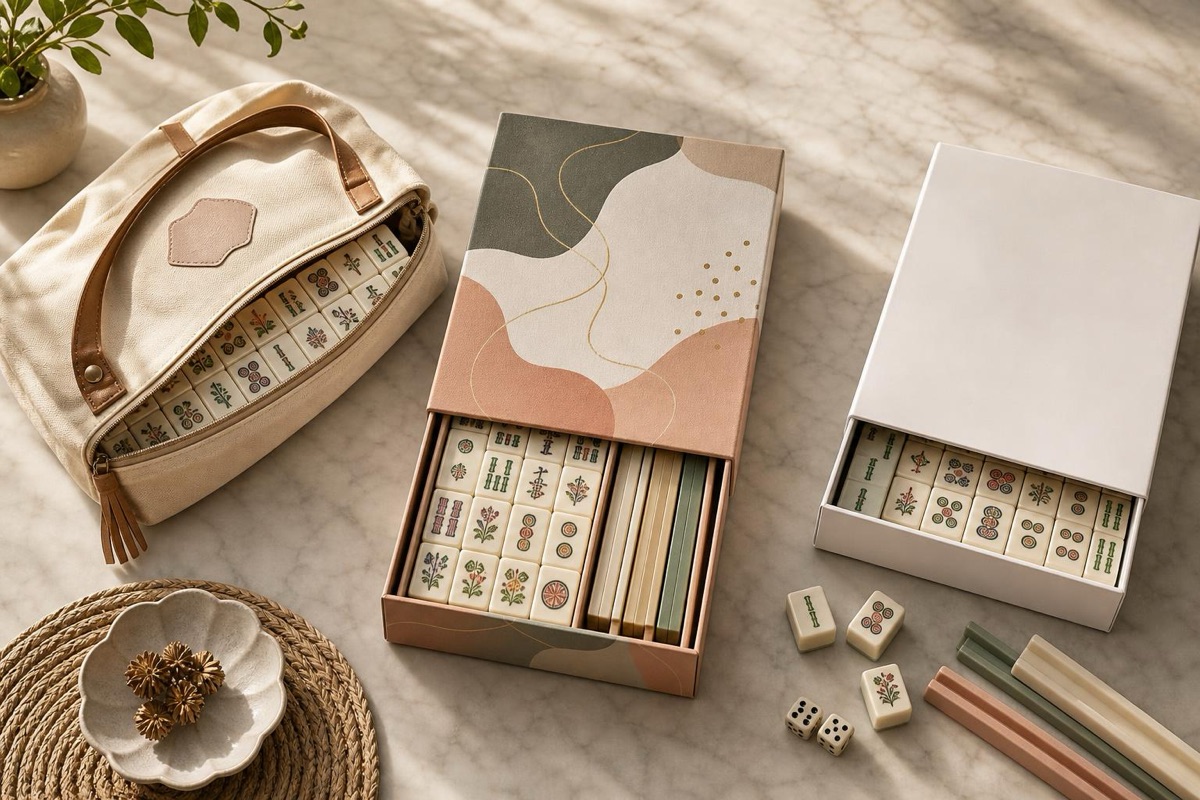
- Boutique-grade accessories — matching acrylic and wooden pushers, custom dice, premium hard cases, canvas tote bags, leatherette cases, branded money chips
- Custom packaging — branded bags, retail boxes, four-color printed gift boxes with foam inserts, UPC labels, hang tags
- Flexible MOQ — starter orders and standard production runs are reviewed by quotation based on scope
- Export-ready — pre-shipment QC photos, packing lists, and freight coordination
- U.S.-focused — understands NMJL requirements, U.S. retail packaging expectations, and American Mahjong market trends
- Full private label and OEM — from logo rebranding on standard designs to fully custom tile faces, custom jokers, unique colorways, and Pantone color matching
For wholesale inquiries, custom quotes, or sample requests, contact Lucky Mahjong at hello@lukmaj.com or visit lukmaj.com.
Frequently Asked Questions
How much does a private label American Mahjong set cost from China?
Private label American Mahjong set cost is confirmed during quotation based on material, tile configuration, customization depth, packaging, accessory list, quantity, and shipping scope. Buyers should request a landed-cost estimate instead of comparing tile-only prices.
What is the minimum order quantity for private label American Mahjong sets?
MOQ should be confirmed during quotation. Basic private label projects may be easier to scope when they use standard tiles and logo packaging, while deeper customization such as custom tile backs, unique jokers, or custom retail packaging usually needs closer production review.
How long does production take?
Production timing is confirmed during quotation after sample scope, artwork approval, order quantity, packaging requirements, and shipping method are reviewed. Custom acrylic sets, complex tile designs, and retail packaging can require longer planning than standard projects.
Can I get samples before placing a bulk order?
Yes. Buyers can request samples before bulk production. Sample cost, sample scope, and shipping are confirmed based on project details, material, customization depth, and order quantity.
How do I know if the factory produces NMJL-compliant sets?
The American Mahjong core contains 152 tiles: 108 suited tiles, 16 winds, 12 dragons, 8 flowers and 8 jokers. A 160-tile retail configuration adds 8 specified extras; a 166-tile configuration adds 14. List the extra faces and quantities in the buyer-approved manifest rather than treating either retail total as a universal requirement.
A factory that can't answer these questions immediately may be producing Chinese Mahjong sets, which have different specifications (144 tiles, no Jokers, Chinese characters). American Mahjong is a distinct U.S. variation with specialized tile configurations and accessories.
Ask specifically: "Can you show real American Mahjong projects you manufactured for boutique brands?" A surprising number of suppliers specialize in Chinese Mahjong, don't understand NMJL layouts, use lightweight printed tiles instead of engraved tiles, and have never made premium U.S.-style sets.
What's the difference between OEM and private label?
OEM (Original Equipment Manufacturing) means the factory produces to your design specifications. Private label typically means the factory's standard product is rebranded with your logo and packaging. For American Mahjong, most U.S. buyers start with private label on a factory's proven design, then move to full OEM as their brand grows.
Buyers ready to move from research to quotation can use the private label American Mahjong sets page for packaging scope and the American Mahjong wholesale supplier page for bulk sourcing details.
Buyer checklist
- Define the first buyer, sales channel and collection scope.
- Budget samples, artwork, inventory, packaging and delivery separately.
- Record sample approval, launch timing and reorder version control.
Production notes
Launch examples are planning guidance, not sales forecasts or fixed commercial terms. Confirm the product scope and approval milestones before making commitments.
Continue your project planning
For a project review, see Private label American Mahjong. The cluster overview connects this decision with the rest of the sourcing process.
Building your private label collection?
Send quantity, tile count, target dimensions, artwork status, accessories, packaging, destination and launch date. These details help define a comparable quotation and sample scope.
Discuss a private label project